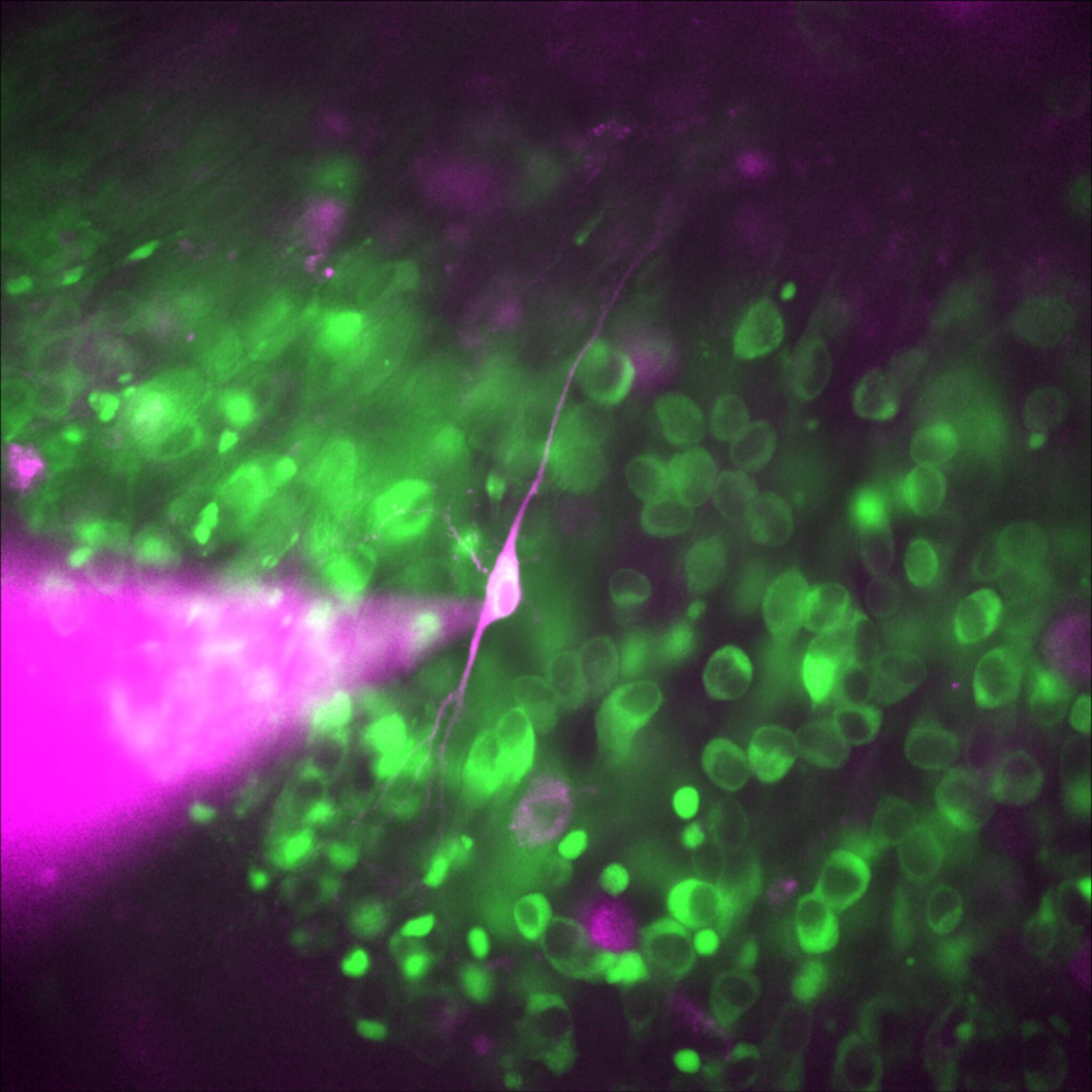
In this edition of Beauty of the Brain, you see brain cells glowing green. That light comes from a special technique that allows postdoc Koen Kole and his colleagues to make calcium inside the cell visible. The cells are coloured with a substance that produces light (fluorescence). When there is a lot of calcium, the cell glows more brightly. When there is little, the glow becomes weaker. This lets researchers follow exactly when the cell releases or takes up calcium. This method is called calcium imaging, and it reveals processes that would otherwise remain completely hidden.
But why is this important? Our brains are made up of billions of tiny cells that “talk” to each other using small electrical signals. This communication only works when many processes inside each cell are carefully coordinated. Calcium plays a major role in this. You can think of it as an on-off switch. When calcium levels are high, certain processes turn on. When calcium levels are low, they turn off. In this way, calcium helps determine how brain cells function and how they pass signals to one another.
Inside every brain cell there is a kind of large storage space for calcium. It consists of a network of thin tubes within the cell. Scientists call this the endoplasmic reticulum (“the cell’s internal network”, or simply ER.
The ER can very precisely control how much calcium is present in the cell. It does this by holding onto calcium or releasing it, and in doing so it can steer many of the cell’s processes. The amount of calcium also affects the electrical signals that brain cells use to communicate. The ER might therefore influence this communication by adjusting calcium levels, but we still don’t fully understand how.
To study this, we measure not only calcium but also the electrical signals of the cell. They do this with an extremely thin needle, thinner than one thousandth of a millimeter. The needle contains a dye that lights up (shown as purple in the image), so they can clearly see which cell is being measured. By looking at both the calcium levels in the ER and the electrical activity of the cells at the same time, researchers hope to understand how this internal network shapes communication between brain cells. This helps us learn how brain cells work together and how the brain processes information.
More Beauty of the Brain